
You are here


Give Your Baby the Best Start with Cryoviva’s Blessing Plan
Not All Cord Blood Is Equal
When you choose cord blood banking, you are planning for your child’s future. But what most parents don’t realize is that the way cord blood is processed matters just as much as storing it. Two samples may both be stored, but one may contain more stem cells, better quality, and higher chances of being useful later. The difference lies in the technology used during processing.
Understanding Cord Blood in Simple Terms
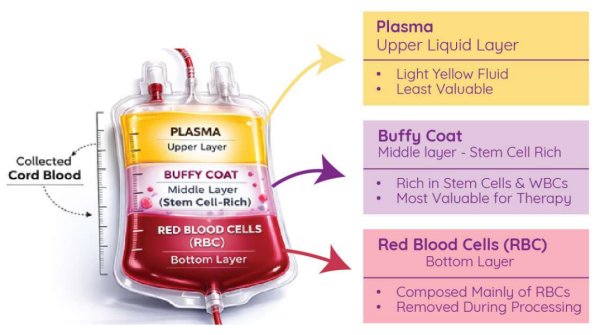
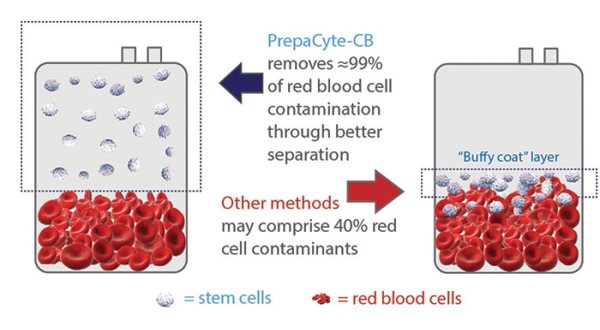
Cord blood contains valuable stem cells that may help in future treatments. At the same time, it also contains unwanted components like red blood cells and haemoglobin. If these are not removed properly, they can affect the quality of the stored sample and even damage the stem cells over time.
Over the years, processing methods have improved significantly since the early work of pioneers like Pablo Rubinstein. Today, the focus is not just on storing cord blood, but on preserving it in the best possible way.
A Real Challenge in India
In India, many cord blood samples are smaller in volume. This is largely because doctors now follow delayed cord clamping, which is beneficial for the baby’s health. However, it also means that less blood is available for collection.
In fact, nearly 40% of samples are less than 40 ml.
With manual pentastarch processing methods:
- Many of these samples are discarded
- Others are stored with very low stem cell counts
This reduces their usefulness in the future.
Introducing the Blessing Plan
Cryoviva’s Blessing Plan combines advanced PrepaCyte® technology with intelligent automation through LMB Supernova.
In simple terms:
- It helps save more stem cells
- It removes more unwanted components
- It ensures consistent and reliable processing.
Precision Automation with LMB Supernova
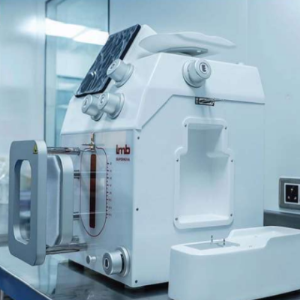 Traditional cord blood processing relies heavily on manual handling, where outcomes can vary depending on operator expertise, sample variability, and procedural inconsistencies. LMB Supernova fundamentally redefines this approach by introducing a fully automated, precision-driven system. It uses advanced optical sensing technology to accurately identify and separate cellular layers, along with algorithm-driven processing that optimizes stem cell recovery in real time. Its closed-system design minimizes contamination risk, while standardized automated protocols ensure consistent and reproducible results across all samples. The result is a process that replaces variability with precision, transforming cord blood processing from an operator-dependent procedure into a controlled, science-driven system.
Why the Blessing Plan Makes a Difference
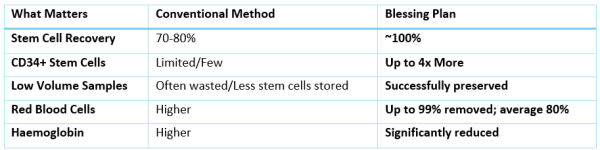
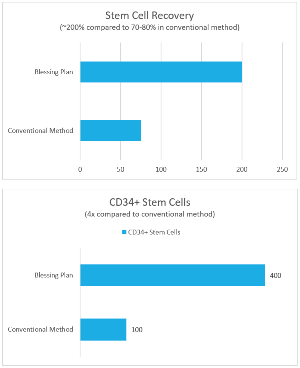
The difference becomes clear when we look at what actually gets stored. With conventional pentastarch and manual methods, stem cell recovery is typically around 70–80%, but with the Blessing Plan, recovery can be significantly higher—reaching close to double in optimized conditions based on internal validation data. This means more useful cells are preserved right from the start. The number of important stem cells, known as CD34+ cells, can be up to four times higher compared to traditional pentastarch-based processing, which directly improves future treatment potential and clinical relevance. In addition, studies evaluating PrepaCyte®-based processing have shown improved colony-forming unit (CFU) recovery, indicating better functional quality of stem cells, which is an important predictor of how well the cells will perform when used.
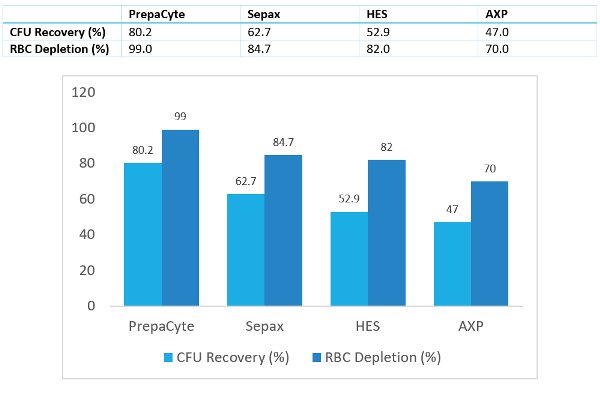
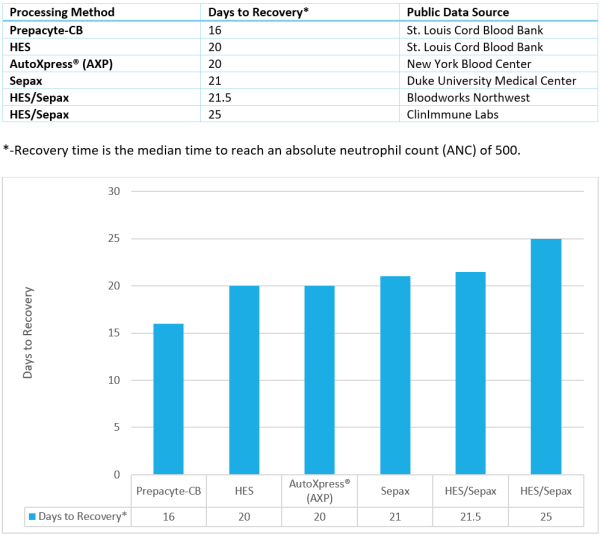
This advantage becomes even more important in real-life situations. In India, where many cord blood samples are small in volume due to delayed cord clamping, traditional methods often struggle to recover enough cells, and some samples are either discarded or stored with limited value. In contrast, the Blessing Plan improves recovery in low-volume samples from around 30% to nearly 80%, ensuring that even smaller collections can still be meaningful and usable. Importantly, published observations from cord blood transplant registries and processing comparisons suggest that higher-quality units with better cell dose and purity are associated with faster early engraftment, especially in terms of neutrophil recovery.
At the same time, the quality of the stored sample is much cleaner. Conventional processing methods tend to leave behind higher levels of red blood cells and haemoglobin, whereas the Blessing Plan removes up to 99% of red blood cells, with practical reductions often around 80% in routine settings, along with a significant reduction in haemoglobin. This results in a purer sample, reduces stress on the stem cells during freezing, and improves their survival and performance when needed in the future.
These observations are supported by internal validation data from Cryoviva as well as published comparisons and educational resources from organizations such as Cryo-Cell International, which highlight the importance of processing methods in determining stem cell recovery, purity, and clinical outcomes.
 Why Technology Matters
PrepaCyte® improves how stem cells are separated and preserved, ensuring higher recovery and better purity. LMB Supernova adds consistency by automating the process, using advanced optical sensors to precisely reduce red blood cell and haemoglobin contamination, and ensuring that every sample is handled with uniform accuracy and care. Together, they ensure that every drop of cord blood is used in the best possible way.
Designed for Real-Life Conditions
As medical practices evolve, delayed cord clamping has become more common because of its benefits for newborn health. However, this also means that smaller cord blood volumes are now a reality. The Blessing Plan is specifically designed to address this challenge, ensuring that even low-volume samples are not wasted and can still deliver meaningful value.
What This Means for Your Baby
For parents, this makes a real difference. Choosing the Blessing Plan means more stem cells are stored, better quality is preserved, and there are higher chances that the sample can actually be used in the future. It ensures that even smaller samples are given the best possible opportunity. It is not just about storing cord blood—it’s about giving your child every possible chance at a healthier, stronger future.
References
- Basford C, Forraz N, Habibollah S, Hanger K, & McGuckin C. The cord blood separation league table: a comparison of the major clinical grade harvesting techniques for cord blood stem cells. Intnl J Stem Cells. 2010; 3(1):32–45.
- Hudspeth D. Evaluation of PrepaCyte®-CB as an alternative to hetastarch methods for processing umbilical cord blood samples. ISCT Telegraft. 2008; 15(4):4-6.
- Regan D, Wofford J, Fortune K, Henderson C, Akel S. Clinical Evaluation of an Alternative Cord Blood Processing Method. Poster presented at AABB Annual Meeting 2011.
- Solves P, Planelles D, Mirabet V, Blanquer A, Carbonell-Uberos F. Qualitative and quantitative cell recovery in umbilical cord blood processed by two automated devices in routine cord blood banking: a comparative study. Blood Transfusion. 2013; 11(3):405–411.
- Cryo-Cell International – PrepaCyte®-CB technical data and processing comparisons.
- Verter F, Schuesler T. The Evolution of Cord Blood Processing and the Role of PrepaCyte. Parent's Guide to Cord Blood Foundation Newsletter Published 2024-06