You are here
Royan’s Phase 1 Trial: Treating Autism with Donated UC-MSC
Royan Stem Cell Technology Company is a public/private cord blood bank in Tehran, Iran, that is spun off from the Royan Institute, a leading Iranian stem cell research center. In July of 2026, they published the results of a clinical trial that used cell therapy to treat five children ages 3-7 years, who had been diagnosed with autism spectrum disorder (ASD)1. The cells used in the study were mesenchymal stromal cells derived from donated umbilical cord tissue (UC-MSC). Each child received three repeated doses of 20 million cells at monthly intervals. The cells were given by intrathecal injection (into the fluid of the spinal cord), administered in the operating room of a children’s hospital under sedation. This trial was registered in April 2020 on the Iranian Registry of Clinical Trials as IRCT20200217046526N3.
While this type of therapy is already offered at a number of commercial clinics in several countries, what makes the Royan open-label trial stand out is the scientific rigor behind how the treatments were given and the outcomes were measured.
First, the safety evaluation followed the children for six months after the first injection and tracked anything that could be considered an adverse event. Many reports from commercial clinics simply say there were no serious adverse events (SAE). This study also did not find any SAEs, but it went further and recorded every adverse event that each child experienced. Every child had at least one transient adverse event from the intrathecal injections, most commonly fever and nausea.
Second, the researchers did not rely on just one way of measuring whether the treatment worked. Parent-reported surveys like the Autism Treatment Evaluation Checklist (ATEC) can be shaped by a parent's hope of seeing improvement, so this study added an independent, clinician-scored assessment as well. In this study, 96 children were screened in order to enroll five participants that had grade II ASD based on the Diagnostic and Statistical Manual of Mental Disorders, Fifth Edition (DSM-5). As part of the screening process, each child was interviewed by an experienced psychiatrist to confirm their diagnosis. During the study, an expert clinician objectively evaluated treatment response on the Childhood Autism Rating Scale (CARS). The CARS scores were taken at the five time intervals: baseline one, two, four, and six months.
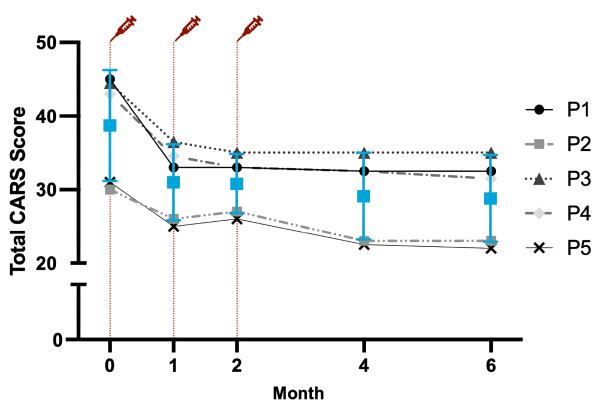
The graph above shows the CARS scores of the five participants over time. The CARS survey consists of 15 areas of behavior which are each rated on a scale from 1 (no impairment) to 4 (severe impairment). The total scores are generally interpreted in these ranges: 15 to 29.5 is non-autistic, 30 to 36.5 is mild-to-moderate autism, and 37 to 60 is severe autism.
According to their CARS scores, behavioral improvements were observed in all of the study participants. Two of the five children moved from CARS scores in the mild-to-moderate autism range into the non-autistic range. The other three children moved from CARS scores of severe autism into the mild-to-moderate autism range. In all of the children, most of the improvement in CARS score happened initially following the first injection, followed by a relative plateau through the six months endpoint.
Outcomes on the ATEC scores taken by parents were not as consistent as the CARS scores taken by clinicians. Initially, all of the children showed significant gains (median 33% change) in the first month, similar to the CARS scores, but whereas the CARS scores plateaued thereafter, the ATEC scores continued to vary. Overall, all of the children finished the study with improved ATEC scores. The two with mild-to-moderate autism lost their autism diagnosis, but two of the three children with severe autism were rated on ATEC by their parents as having some regression after the initial response.
Third, this study also investigated the hypothesis that children with autism could benefit from therapy that helps them to regulate their immune system. Mesenchymal stromal cells have been documented to have immunomodulatory and neuroprotective properties. In this study, the cytokine profile of each child’s cerebrospinal fluid was measured prior to each injection. It was found that cytokine markers of inflammation consistently decreased over the first two months, especially the TNF-α and IL-6 levels. All participants had lower inflammatory cytokine levels and lower white blood counts at the end of the study.
The children also had brain scans and brainwave recordings under general anesthesia at the start of the study and at the final visit. Electroencephalography (EEG) metrics suggested that the participants shifted towards more relaxed wakefulness and active cognitive processing. Diffusion Tensor Imaging (DTI) did not show significant structural remodeling of the brain tracts.
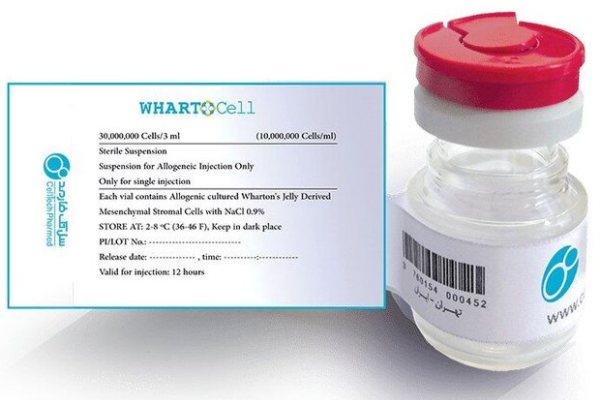
Finally, it is notable that the UC-MSC product used in this study, called Whartocell®, has recently received market approval from the Biological Products Department of Iran's Food and Drug Administration as an off-the-shelf therapy for the treatment of knee osteoarthritis and children with Cerebral Palsy2. Whartocell® was researched and developed at Royan Stem Cell Technology Co. and is manufactured under Good Manufacturing Practice (GMP) standards by CellTech Pharmed company. It is remarkable that the scientists and doctors conducting this study in Iran have managed to continue their work despite the disruptions of war, and that their Food and Drug Administration is embracing a proactive role in the development of regenerative medicine therapies.
References
- Khodadoust E, Zarafshan H, Nouri M, Majmaa A, Khaleghi A, Zamani F, ... Mohammadi MR. Three repeated intrathecal injections of allogenic umbilical cord-derived mesenchymal stromal cells in autism spectrum disorder: a Phase I clinical trial. Stem Cell Res. & Therapy. 30 July 2026; in press
- ISNA. Iran Launches WhartoCell, Umbilical Cord Cell Therapy for Osteoarthritis. Iranian Students' News Agency. Science News. Published 2026-06-27