
You are here

Interview with Nina Horowitz of ImmuneBridge
This month, Parent’s Guide to Cord Blood Foundation (PGCB) is interviewing Nina Horowitz, PhD, who is the CEO of ImmuneBridge.
PGCB: Let’s start with the history of ImmuneBridge. The company was founded in 2018 by Jesse Cotari, PhD, and Peretz Partensky, PhD. Dr. Cotari and colleagues patented methods to expand hematopoietic stem cells (HSC). This was the discovery of IBR403, ImmuneBridge’s proprietary small molecule that induces up to 100,000-fold HSC proliferation while preserving full multipotency. Can you tell us anything about the process through which IBR403 was identified and developed?
The search for the ideal HSC expansion technology was a massive chemical screening process that was conducted over the course of six years. The project was funded by Alex Jacobson, a private investor who is currently on the board of ImmuneBridge. The molecule IBR403 is not the 403rd molecule that was tested; the numbers are a code based on the molecular structure. In addition to IBR403, Cotari et al. patented several related molecules that also produce high proliferation and which might prove to work better for certain cell types.
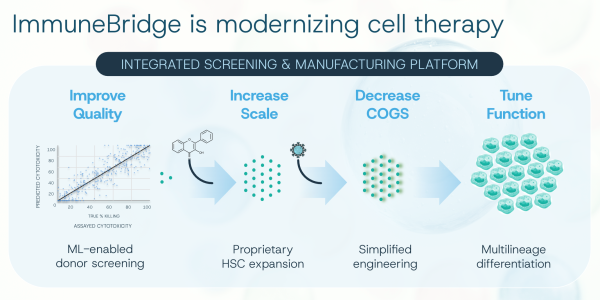
PGCB: It is important to emphasize to our readers how phenomenal it is that IBR403 enables a 100K-fold expansion of HSC. This is a thousand times more powerful than competing HSC expansion methods. Over the past twenty years, entire companies have been built and have run multiple clinical trials, based on technologies that expand HSC less than 100-fold1-4.
The first product in the ImmuneBridge pipeline is to manufacture Natural Killer (NK) cells from cord blood as a cancer immunotherapy. It is well-established that NK cells naturally fight cancer (they are cytoxic) and can be given from donor to patient without genetic matching5. The huge expansion capacity of IBR403 enables ImmuneBridge to overcome the manufacturing bottlenecks that previously limited NK therapies: NK cells only comprise a few percent of blood cells, and they are difficult to expand. Instead, ImmuneBridge expands the entire cell population that is positive for the marker CD34 and then matures NK cells from the progenitors.
Another problem solved by the huge expansion capacity of IBR403 is the well-known variability of NK cells from one donor to another6. To handle this issue, ImmuneBridge partnered with the NMDP network of public cord blood banks. First ImmuneBridge obtained 100 μL testing segments from 100 cord blood units, and expanded them enough to run a multi-parameter analysis to identify the optimum cord blood donors. Then ImmuneBridge purchased the 10 best cord blood units to be the basis of their product. ImmuneBridge also relies on a stirred tank bioreactor to grow cells at scale7,8.
It is important to note that ImmuneBridge cares about keeping therapies affordable. Their NK cell manufacturing process has three steps: (1) expand CD34+ progenitors, (2) differentiate NK cells, and (3) expand the NK cells. The step (3) is not necessary, given the huge expansion in step (1), but doing it this way allows them to lower the final cost per dose significantly.
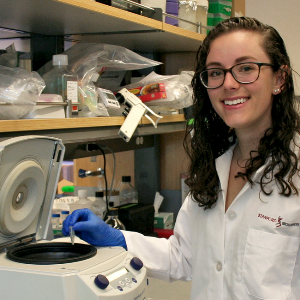 PGCB: We also want to know about the background of Nina Horowitz. In 2018, when ImmuneBridge was founded, you were working on your PhD at Stanford. Did you always know that you wanted to pursue a career in biotech, or did you take some detours along the way?
Nina has a classic tug-at-the-heartstrings story: At age eight years old she was diagnosed with a malignant ovarian teratoma. This is rare cancer, especially to be found in a child, and there was no established treatment protocol. After her ovary was removed, there was a debate about whether or not to do chemotherapy. Nina cut her hair short in preparation, but at the last moment the decision was made not to do chemo because it carried too much risk without clear benefit. Ever since this childhood experience, Nina has known that she wanted to cure cancer.
As a nerdy kid that loved science, Nina was fascinated by synthetic biology. But she didn’t see a way to link this interest to her life goal of curing cancer. That changed when she learned about CAR-T therapy. Suddenly she realized that synthetic biology could cure cancer. That was a “lightning bolt moment”.
PGCB: Your PhD thesis, which was just published in May 2026 in Science, is about cytoxic tissue-resident NK cells (ctrNK). You identified a sub-population of ctrNK cells, differentiated upon exposure to epithelial tumor cells, which are superior to blood-derived NK cells in their ability to kill tumor cells and to infiltrate solid tumor microenvironments10. Do you plan to incorporate this research into your work with ImmuneBridge?
Nina notes that the ability to use tissue-resident NK cells is relevant for certain disease indications and methods of treatment delivery. What Nina took away from the work on ctrNK, is that “NK phenotype matters more than we think”. The phenotype of a cell combines physical traits, functions, and behaviors; these are determined by the history of the cell's interactions with its environment and neighboring cells. The experience from her PhD carries into the work with ImmuneBridge, because it made her realize that every choice in the manufacturing process matters.
PGCB: How did you end up joining ImmuneBridge when you finished your PhD in 2022, and becoming their CEO at the end of 2025?
Nina met Jesse Cotari, the co-founder of ImmuneBridge, at a conference about NK cells. To her surprise, a team from ImmuneBridge showed up at her PhD thesis defense in the spring of 2022. So effectively, her thesis defense became a job interview. She started working for ImmuneBridge a month before her PhD became official.
Nina’s path from CSO to CEO evolved to fill the company’s needs. “At any small start-up, you need to find the overlap of what you’re good at and what’s needed.” Nina is originally from the New York City area, and has what is called “the gift of gab”. She could talk to investors, she was knowledgeable, motivated, and willing to work 10+ hours per day. Their seed investor Alex Jacobson took her under his wing; they worked on pitch decks and delivered pitches together. All of this prepared Nina to take over as CEO.
Nina says “It’s a huge privilege to be a CEO at my age”, and she genuinely enjoys most of it. But she still sits in on every science meeting, “much to chagrin of the scientists”. Nina feels that her end goal is to help patients, not necessarily to be a CEO. If a time came when it would advance the company to hire an outside CEO, and have Nina return to the CSO role, she would be happy to switch.

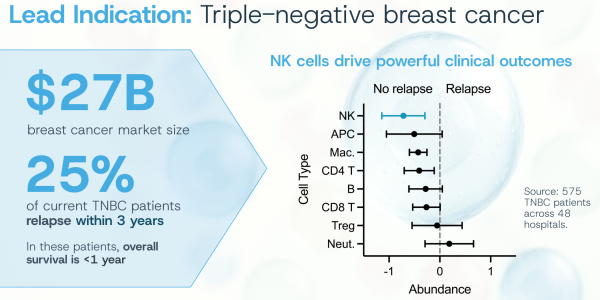
PGCB: This leads us to the product pipeline of ImmuneBridge. According to the slide deck for investors, ImmuneBridge’s lead indication is to develop an anti-TROP2 CAR-NK immunotherapy for triple-negative breast cancer (TNBC). Currently, 25% of TNBC patients relapse within three years, and the latest drugs introduced for this diagnosis have not improved survival. Beyond this indication, ImmuneBridge lists seven partnerships developing products with other types of immune cells that can be derived from expanded HSC. What can you tell us about the ImmuneBridge product portfolio?
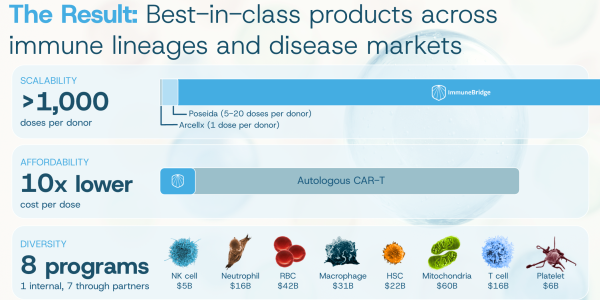
Right now, ImmuneBridge is focused on IND-enabling animal studies that will lead to a clinical trial for triple-negative breast cancer. The other projects with partners are confidential, and very early stage. The point of displaying them on the slide deck was to emphasize that the ImmuneBridge technology can work across all immune lineages that come from CD34+ progenitors, and none of these projects will compete with each other.
PGCB: Our readers will want to know how ImmuneBridge could impact the cord blood banking industry. Will ImmuneBridge be using donated cord blood as the starting material for all of their immunotherapy cell lines? Also, does ImmuneBridge intend to enter the field of transplants with expanded cord blood, or stay focused on deriving specific cell types for immunotherapy?
ImmuneBridge will rely 100% on cord blood for their internal product pipeline. Nina is on the NMDP cord blood advisory committee. She loves cord blood. Cord blood is the best source for developing immunotherapies because cord blood has: longer telomeres, healthier mitochondria, no contamination, little exposure to viruses, larger proliferative capacity, and it is already FDA approved. The fact that public cord blood banks already have BLA licenses is an important part of why cord blood is such a good resource for developing immunotherapies. On top of all its other attributes, the cord blood inventory is genetically diverse: “All ethnicities, both genders, every horoscope sign.”
According to Nina, the only bad thing about cord blood is YOBO – You’re Only Born Once. If they find the perfect donor, they can’t go back to ask for more cord blood. You’d better expand those cells like crazy!
ImmuneBridge has no intention of going into the business of providing expanded cord blood transplants. In theory, ImmuneBridge could out-expand the companies currently in the expansion business. However, it would not be a cost-effective approach. Stem cell transplants are a niche market where every product is developed for a single patient. The ImmuneBridge expansion would produce multiple transplant units, when only one is needed for the patient, and there is no pathway to use the extras. ImmuneBridge prefers to develop therapies that are not genetically matched and target more common medical conditions, so that their ability to treat many patients at an affordable price is valuable.
PGCB: Would ImmuneBridge consider becoming a contract manufacturer for cell therapies? The ImmuneBridge technology could become the de facto choice for CD34+ progenitor expansion, prior to each group from industry or academia deriving their own specific cell lineages and applying their own cell engineering.
ImmuneBridge has no interest in being a CDMO. There are plenty of good ones out there. In the service industry, you have less control and smaller profit margin. ImmuneBridge wants to be a therapeutics platform.
PGCB: Financially, the future looks bright for ImmuneBridge. Currently, the company is owned by 16 venture capital firms. In March of 2026, ImmuneBridge raised $7.7 million in a second round of seed funding11. That is a remarkable achievement during an era when biotech investors have been described as “risk averse”, focused on funding late stage companies at the expense of start-ups12. What are the next steps for ImmuneBridge?
ImmuneBridge is still a start-up company. In order to be successful, they seek to develop a therapy which meets a huge unmet need. They will only get funded for one clinical trial before they either succeed or fail. They want to target an indication and a treatment approach where they can succeed, and emerge from the development pipeline with a blockbuster product. This is why their lead indication is the anti-TROP2 target for TNBC, where the only competition is academic trials13.
PGCB: What are your thoughts on the current competition between multiple types of NK cell therapy products?
Nina thinks that the field of NK cell therapy does not feel very competitive. The conferences in this field are small, and everyone talks to each other. There is a spirit of collaboration. ImmuneBridge feels their role is not to compete, but to supplement.
In the cell and gene therapy industry, a rising tide will float all boats. Currently the company Artiva is going into a phase 3 trial with an allogeneic NK cell therapy for the auto-immune disorder Rheumatoid Arthritis. That is good news for all companies in the NK space. But there are currently 17 companies developing NK therapies for auto-immune indications, and ImmuneBridge doesn’t want to enter this arena as a pre-clinical company.
PGCB: Do you see in any value in storing personal NK cells? Cord blood banks in some parts of the world, especially Asia, offer their clients storage of their own immune cells and also supply donated cells to clinics for longevity treatments.
Nina agrees that for patients going through chemotherapy, banking their own immune cells in advance is a good idea, so they can reset their immune system afterwards. But she warns that banking personal NK cells will not be useful for treating future cancers, because NK cells work best when there is a graft vs tumor mismatch, so allogeneic NK products are better for cancer therapy.
Nina explains that longevity research was one of the motivations behind the original search for the expansion molecule IBR403. The idea is that your immune system keeps you younger, so banking your own immune cells for future longevity treatments is a form of self-parabiosis14. The question becomes, what is the clinically effective dose, so you know how many cells you need to bank? It quickly becomes clear that the number of cells you can safely take from yourself is far less than would be clinically effective. These thoughts motivated the search for a powerful method of expanding HSC.
References
- Boitano AE, Wang J, Romeo R, Bouchez LC, Parker AE, Sutton SE, .... Cooke MP. Aryl Hydrocarbon Receptor Antagonists Promote the Expansion of Human Hematopoietic Stem Cells. Science 2010; 329(5997):1345-1348.
- Peled T, Shoham H, Aschengrau D, Yackoubov D, Frei G, Rosenheimer N, ... Peled A. Nicotinamide, a SIRT1 inhibitor, inhibits differentiation and facilitates expansion of hematopoietic progenitor cells with enhanced bone marrow homing and engraftment. Experimental Hematology. 2012; 40(4):342-355.e1.
- Cohen S, Roy J, Lachance S, Marinier A, Delisle JS, Roy DC, ... Sauvageau G. Single UM171 expanded cord blood transplant is feasible and safe, accelerates engraftment, reduces hospitalization length and most importantly improves HLA matching. Experimental Hematology. 2017; 53(Suppl):S48-S49.
- Sakurai M, Ishitsuka K, Becker HJ, Yamazaki S. Ex vivo expansion of human hematopoietic stem cells and clinical applications. Cancer Science. 2024; 115(3):698-705.
- Rezvani, K. Adoptive cell therapy using engineered natural killer cells. Bone Marrow Transplant 2019; 54(Suppl 2):785–788.
- Kusch N, Storm J, Macioszek A, Knabbe C, Kaltschmidt B, Kaltschmidt C. Donor Variability and Seeding Density Shape NK-Cell Proliferation and Surface Receptor Expression: Insights from an Integrated Phenotypic and Genetic Analysis. Cells. 2025; 14(16):1252.
- Eppolito G, Ladi R, Shek K, Burden E, Devine S, Roberto M, ... Tostoes R. Scalable Hematopoietic Stem Cell Expansion in Stirred-Tank Bioreactors for Advancing Cell Immunotherapies. Cytotherapy. 2025; 27(5Suppl):S98.
- Hanson Wade Group. Building Bridges to Scalable Allogeneic Cell Therapy. News Medical Life Sciences. Published 2025-05-27
- Otegbeye F, Cooper B, Caimi P, ... Wald D. A Phase I Study to Determine the Maximum Tolerated Dose of ex Vivo Expanded Natural Killer Cells Derived from Unrelated, HLA-Disparate Adult Donors. ASTCT journal. 2022; 28(5):250.e1-250.e8.
- Horowitz NB, Mohammad IA, Shin JH, Hickey JW, Chockley P, Gail Snyder, ... Sunwoo JB. CD39+CD49a+CD103+ cytotoxic tissue-resident natural killer cells infiltrate and control solid epithelial tumor growth in mice. Science Translational Medicine. 2026; 18(848):1-16.
- ImmuneBridge. ImmuneBridge Raises $7.7M. Announcements. Published 2026-03-23
- Mendoza AB. A Blueprint for Early-Stage Success. Blueprint for Breakthroughs. Published 2025-02-11
- Ranek JS, Greenwald NF, Goldston M. et al. The automated computational workflow QUICHE reveals structural definitions of antitumor responses in triple-negative breast cancer. Nature Cancer. 2026; 7(3):451-468.
- Verter F. Cord Blood and Anti-Aging. Parent's Guide to Cord Blood Foundation Newsletter Published 2023-10