
You are here
Interview with Ajay Vishwakarma and Alexey Bersenev of Cell BioEngines
This month, Parent’s Guide to Cord Blood Foundation (PGCB) is interviewing the founders of Cell BioEngines, a relatively new company in the field of cord blood expansion. Their lead product SAVI-CORD™ is an off-the-shelf graft source which can provide rapid stem cell transplants for patients that can’t wait.
Cell BioEngines operates from the perspective that expanded cord blood transplants are now an established treatment modality. The next steps are to make this treatment more effective and more scalable for larger numbers of patients. One unmet need is treatments for patients that are suffering from relapse of a hematologic malignancy after failure of a stem cell transplant or CAR-T cell therapy. These patients could benefit from a rescue transplant with an off-the-shelf cell therapy.
Cell BioEngines is headquartered in New York after incorporation in Delaware in December 2022. The company came out of stealth mode in April 2023 after pre-seed venture financing from SOSV. The co-founders are Ajay Vishwakarma, DMD MSc MBA, and Alexey Bersenev, MD PhD. Ajay serves as the CEO of Cell BioEngines, and Alexey is a scientific advisor to the company.
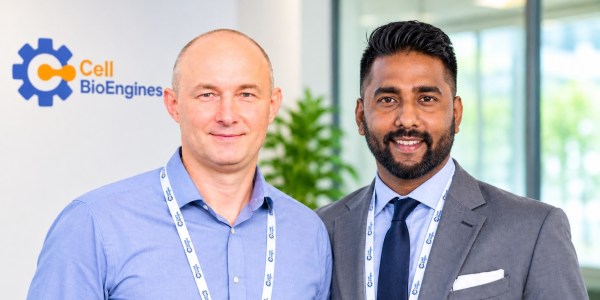
Cell BioEngines founders (left)Alexey Bersenev, MD PhD, and (right) Ajay Vishwakarma, DMD MSc MBA.
PGCB: Did you invent or license your cord blood expansion process?
Both. The method of expanding cord blood with valproic acid (VPA) was invented at Mount Sinai School of Medicine by Pratima Chaurasia, PhD, and Ronald Hoffman, MD1. Cell BioEngines holds the exclusive worldwide licenses from Mount Sinai (2023) for VPA-expanded blood stem cells. The U.S. patent is issued, with counterparts in Canada, Japan and China; the EU application is pending.
Cell BioEngines has also filed three of its own patent applications that cover: the composition of matter; the chemistry, manufacturing and controls (CMC); and the method of treatment. These are regarded as separate inventions that are owned by the company.
PGCB: What is the expansion technology to create SAVI-CORD™?
- VPA is a small-molecule HDAC inhibitor. During a short (about one-week) ex vivo culture, it epigenetically reprograms cord blood CD34+ hematopoietic progenitor/stem cells: chromatin opens, stemness genes are reactivated, and markers such as CD90, CD49f, c-Kit and CXCR4 increase. The goal is to expand and maintain true long-term HSCs, not just bulk CD34+ progenitor cells.
- The SAVI-CORD™ product creates two components from one cord blood unit: the expanded CD34+ fraction for engraftment, plus the unexpanded CD34− fraction, which retains T-cells for a graft-versus-leukemia effect.
- The process of creating SAVI-CORD™ starts by selecting HLA-homozygous cord blood units that are compatible with multiple patients.
PGCB: How does SAVI-CORD™ compare to other expanded cord blood transplants?
The product Omisirge® from Gamida Cell is the best-known expanded cord blood product on the market for hematopoietic transplants2. This product relies on expansion with the molecule nicotinamide. Omisirge® was designed to transplant a single patient and achieve neutrophil engraftment that is faster than a bone marrow transplant. Omisirge® received FDA approval in April 20233.
The second well-known expanded cord blood product for transplants is Zemcelpro® from ExCellThera. It relies on expansion with the molecule UM-171 and it has conditional approval from the European Commission4,5. Like the Gamida Cell product, ExCellThera creates a personalized expanded product to transplant a single patient. Unlike Gamida Cell, ExCellThera is not focused on speeding engraftment but is focused on expanding long-term Hematopoietic Stem Cells (HSC).
The table below gives a high-level comparison between the Cell BioEngines expanded product versus the products from Gamida Cell and ExCellThera. Caveat: this is not a head-to-head comparison. In the clinical data for these products, the patient populations, line of therapy, conditioning, and follow-up all differ.
Parameter | Cell BioEngines: | Gamida Cell: Omisirge® | ExCellThera: Zemcelpro® |
Starting material | Umbilical cord blood | Umbilical cord blood | Umbilical cord blood |
Core technology | Proprietary chemical and biological cell-fate programming | Nicotinamide-based expansion | UM171 small-molecule expansion |
Cell modification | Transgene-free; no genetic modification | No genetic modification | No genetic modification |
Primary objective | Expand HSC to generate multiple off-the-shelf doses. | Expand HSC to speed neutrophil engraftment. | Expand HSC to boost cord blood cell dose. |
Manufacturing concept | Ex vivo expansion of HLA-selected cord blood HSC | Ex vivo expansion of cord blood HSC | Ex vivo expansion of cord blood HSC |
Manufacturing time | One week | Four weeks | One week |
Clinical development | Phase 1 completed at Mount Sinai; Phase 1b/2a (RESTORE) planned | FDA-approved product | EU conditional marketing authorization |
A key difference between SAVI-CORD™ and previous technologies for expanded cord blood transplants is that SAVI-CORD™ is intended to treat multiple patients with an off-the-shelf product. This is done through a combination of careful donor selection and proprietary expansion technology.
The starting point of creating SAVI-CORD™ is to select cord blood “super donors” that are compatible with multiple patients. Expanding the cells of these donors creates multiple cryopreserved therapeutic doses from a single cord blood unit. This makes it possible to build a scalable inventory of transplant-ready units rather than searching for a matching cord blood unit to expand every time a patient needs transplantation.
PGCB: How difficult is it get the homozygous CBU needed to start the process?
This is one of the most critical aspects of our business model. Cell BioEngines starts with cord blood units (CBU) that are “HLA-homozygous”. This means that the donor has inherited the same HLA haplotype from both parents. Whereas a random donor has 8 important HLA types, an HLA-homozygous donor only has 4 different types. Working with an HLA-homozygous donor, it is much easier to achieve a 5/8 HLA match with multiple patients.
HLA-homozygous cord blood units are naturally occurring but relatively uncommon6. The challenge is to identify and reserve CBU that have the right HLA characteristics, sufficient starting cell counts, and acceptable quality. To do this, Cell BioEngines has a procurement agreement with NMDP.
Longer term, Cell BioEngines hopes to establish a dedicated cord blood bank that contains prospectively identified cord blood donors, rather than retrospectively searching for HLA-homozygous units among existing cord blood donations. The key to this effort is to map the existing HLA variations in the US population and predict the frequency and identity of the HLA-homozygous donors. To do this, Cell BioEngines has created an affiliate company Cell BioPharma, dba National HLA Biobank Institute (NHBI).
PGCB: How many patients can receive a SAVI-CORD™ transplant from a single CBU?
This is under study. Our current therapeutic goal is a CD34+ cell dose of approximately 0.2 million cells/kg. For planning purposes, this translates to approximately 20 million cells for a single-dose product or 40 million cells for a two-dose treatment strategy, depending on the patient and protocol. We will set a firm number of doses per CBU once the manufacturing process, cell recovery, and release specifications are validated at scale.
PGCB: How are the SAVI-CORD™ doses stored until they are needed?
Bear in mind that the SAVI-CORD™ product consists of two components: an expanded CD34+ fraction and the unexpanded CD34- fraction. Both fractions are frozen in a controlled-rate freezer and held in vapor-phase cryogenic nitrogen until infusion.
Our CDMO partner is Miltenyi Bioindustry. We are working with the closed, automated CliniMACS Prodigy cell-processing systems, and we have set up our own process-development laboratory.
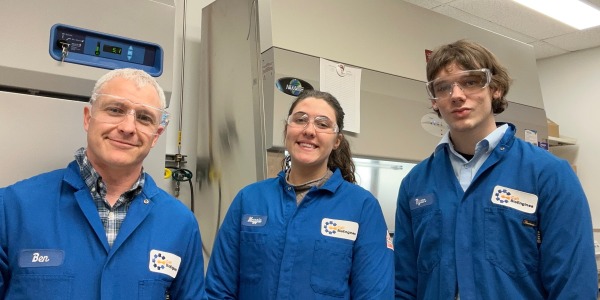
Cell BioEngines lab team (left to right) Benjamin Harman PhD, Margaret Morris, Ryan Munyon.
PGCB: Has SAVI-CORD™ been used to treat patients?
Yes. A single-site Phase 1 clinical trial was run at Mount Sinai, ClinicalTrials.gov NCT03885947. The results have been presented in a poster at the American Society of Cell + Gene Therapy (ASGCT).
- Patients were ages 12–65 and transplanted first-line for AML, ALL, or MDS.
- Seven patients were enrolled but only five were dosed; the other two were not dosed due to manufacturing failures.
- The patients were co-infused with an unmanipulated backup CBU.
- These five patients have now been followed for five years.
- All five patients engrafted: neutrophils at days 17–23 and platelets at days 27–41.
- No relapse has occurred, including in MRD+ patients and one patient with active disease.
- Four of the five patients are alive and disease-free at 5–6+ years. One patient died at day 236 of an unrelated CNS event.
- Grade I–II skin GvHD occurred in four of five, with no cases of severe GvHD.
Currently, Cell BioEngines is planning a clinical trial to be named RESTORE. It will be a Phase 1b/2a trial of SAVI-CORD™ in patients that relapsed after allogeneic HSCT or CAR-T therapy. Dosing of the first patient is targeted for June 2027, with a Cohort A interim readout around Q4 2027.
PGCB: How did Ajay and Alexey come together to found Cell BioEngines?
Ajay grew up in Mumbai, India, and moved to the US in 2013 as an immune engineering postdoc at Harvard-MIT, after completing a Doctor of Medicine in Dental Surgery and a master’s in tissue engineering and regenerative medicine at Cardiff University. He began to pursue a PhD in cancer biology at Carver College of Medicine and Harvard Medical School. His research fostered a love for the biotech industry: instead of treating individual patients, he wanted to help develop medicines for millions. During the COVID-19 shut-down, Ajay left his PhD to pursue drug development, and in December 2022 he founded Cell BioEngines, becoming CEO and President of the cell therapy company. Ajay is focused on building off-the-shelf, HLA-matched cell products from umbilical cord blood stem cells.
Alexey is from Russia, where he became certified as a general surgeon and attained a PhD in transplantation/ pathology. In 2003, Alexey came to the US, where he spent six years as a postdoc at Thomas Jefferson University and at Children’s Hospital of Philadelphia. Next, Alexey began working at the University of Pennsylvania, where he learned how to manage clinical cell processing in a GMP cell manufacturing facility. Since Feb. 2015, Alexey is the Facility Director at Yale University for both the Clinical Cell Therapy Processing Laboratory and the Advanced Cell Therapy Laboratory.
Ajay and Alexey first connected via email in 2013, but the spark that launched Cell BioEngines came during the pandemic in 2020. One day Ajay reached out to Alexey with the proposition: “Let’s build a stem cell-derived therapeutics company.” What began as an idea between two scientists with complementary expertise and a shared vision, has ultimately led to a company focused on harnessing the potential of donor-derived cord blood stem cells to engineer the next generation of scalable, off-the-shelf cell therapies.
PGCB: What role do you see Cell BioEngines playing in the transplant field?
Our goal is to be the off-the-shelf expanded cord blood graft for patients who can’t immediately find a matched donor with sufficient cell dose.
The initial market for Cell Bioengines will be oncology patients that relapse after first-line treatment. There are now close to 10,000 allogeneic stem cell transplants per year in the US, and over 10,000 CAR-T therapies per year7,8. The number of patients that are eligible for CAR-T therapy is roughly five-fold the number that receive access to CAR-T therapy9. But for those oncology patients that relapse after CAR-T therapy, the survival rate is only about 20%, so there is a great need for a rescue therapy10. Next after oncology patients in relapse, Cell BioEngines would target nonmalignant hematology conditions (beta-thalassemia, aplastic anemia, Fanconi anemia), and later autoimmune diseases (multiple sclerosis, systemic sclerosis, Crohn’s disease).
References
- Chaurasia P, Gajzer DC, Schaniel C, D’Souza S, Hoffman R. Epigenetic reprogramming induces the expansion of cord blood stem cells. J Clinical Investigation. 2014; 124(6):2378-2395.
- Verter F. Update on Omidubicel from Gamida Cell: Phase 3 Trial Outcomes. Parent's Guide to Cord Blood Foundation Newsletter. Published 2021-03
- U.S. Food and Drug Administration. FDA Approves Cell Therapy for Patients with Blood Cancers to Reduce Risk of Infection Following Stem Cell Transplantation. News Release. Published 2023-04-17
- Verter F. ExCellThera Can Improve Patient Access to Cord Blood Transplants. Parent's Guide to Cord Blood Foundation Newsletter. Published 2022-09
- ExCellThera. Zemcelpro® (UM171 Cell Therapy) receives EC authorization as the first and only cell therapy for blood cancer patients without access to suitable donor cells. Press Release. Published 2025-08-27
- Naumovas D, Rojas-Araya B, Polanco CM, Andrade V, Čekauskienė R, Valatkaitė-Rakštienė B, ... Arias J. Identification of HLA-A, HLA-B, and HLA-C triple homozygous and double homozygous donors: a path toward synthetic superdonor advanced therapeutic medicinal products. Frontiers Immunology. 2025; 16:1626787.
- Center for International Blood and Marrow Transplant Research. 2025 CIBMTR Annual Report. Published 2026
- Gibb S. So… how many people have actually been treated with CAR-T? LinkedIn blog. Published 2025-07-10
- CAR-T Vision. Patient access to CAR T-cell therapy: a mismatch between eligible patients and actual patients treated. Patient advocacy website. Accessed 2026-11-01
- Erbella F, Bachy E, Cartron G, Gat E, Manson G, Morschhauser F, ... Di Blasi R. Late failure of aggressive B-cell lymphoma after CAR T-cell therapy: a LYSA study from the DESCAR-T registry. Blood Advances. 2026; 10(2):392–401.