You are here
Implementing Cord Blood Therapy for Cerebral Palsy in the US
Last year (April 2025), the American Academy of Pediatrics published evidence that cord blood therapy has a large treatment benefit for improving gross motor skills of children with cerebral palsy1. Within 6-12 months of treatment, 68% of the children who received cord blood therapy had GMFM-66 scores that were higher than the control group. The cord blood therapy consists of an intravenous infusion of cord blood stem cells for most children, although in some cases the cells were delivered as an intrathecal injection. Children benefited from receiving either their own autologous cells or allogeneic cells from a donor. There was a trend of better response with higher stem cell dose, providing the dose was above 50 million cells per kg.
On the heels of this proof of efficacy, the question becomes:
How can we implement this therapy in more clinical settings?
To answer that question, visiting Fulbright Scholar Madison Paton, PhD, conducted a series of structured interviews with US-based professionals that had direct experience in delivering cord blood therapy for cerebral palsy. Those interviews, published August 2026 in a peer-reviewed journal, identified five theme topics that captured shared insights from the participants2. Each theme describes program ingredients that could either enable or hinder the implementation of more programs to offer cord blood therapy for cerebral palsy.
The five theme topics:
- Clinical leadership & collaboration, community priorities
- Procedures, setting and cost
- Safety and efficacy evidence, looking to the future
- Trust and reputation through research & experience
- Resourcing, infrastructure & commercial appeal
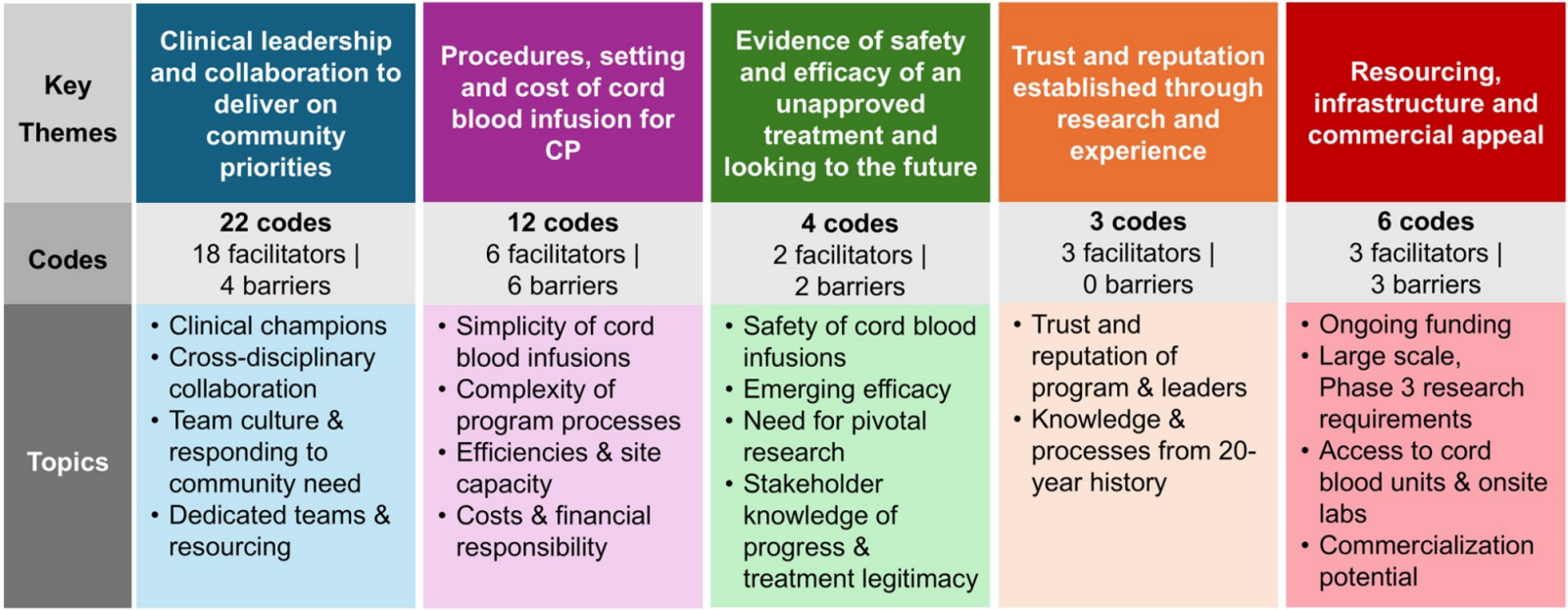
This table copyright by Paton et al. Stem Cells Translational Medicine 2026. Click to see full size.
Below we devote a paragraph to each of these categories.
Leadership: Clinical leadership is a necessary ingredient to enable coordination across pediatric medical disciplines that traditionally do not intersect, ranging from neurology to hematology. Leadership is key to developing sustained institutional engagement in a clinical environment that is primarily oriented towards oncology indications. This leadership role is not readily replicated. Moreover, a successful clinical champion is aware of and can channel the unmet community demand for novel cerebral palsy therapies.
Procedures, setting, cost: The procedure of giving the cord blood infusion typically takes a few hours, but it is proceeded by a great deal of regulatory and clinical work-up. Cord blood infusions have an advantage as a therapeutic procedure because they are backed by decades of experience in oncology that have developed infrastructure and standards for delivering this product. Nonetheless, there can be resource competition to get an outpatient bed in an oncology clinic for the purpose of treating a neurologic condition. Finally, the costs that parents pay to participate in expanded access programs raise substantial ethical questions about equity of access.
Evidence of safety and efficacy: Despite substantial evidence that cord blood therapy for cerebral palsy is safe and shows preliminary efficacy, it still does not have FDA market approval because no one has been able to raise the funding to run a phase 3 clinical trial in the US. Participants in expanded access programs hope that eventually the FDA will grant approval based on Real World Evidence. In the meantime, this therapy suffers under the stigma of being an “unapproved treatment”, which is an obstacle to wider adoption.
Trust and reputation: Currently, cord blood therapy for cerebral palsy is only legally available in the US via the expanded access program at Duke University Medical Center. This elite hospital inspires trust, which helps with fundraising and regulatory approvals.
Commercial appeal: The use of cord blood as a therapy for cerebral palsy has limited commercial potential. Because the procedure is generic and cannot be patented, it will not garner the interest of a pharma company that could develop it in exchange for commercial rights. As a result, there is no corporate backing to finance a phase 3 clinical trial. This is described in the report as a “misalignment between societal value and market logic”.
What conclusions can we draw about the ability to implement cord blood therapy for cerebral palsy elsewhere? Two major system-level barriers are limited awareness of the treatment and the lack of insurance coverage for the treatment. However, these hurdles are not unique to this therapy, and can eventually be overcome. Participants in the study cautioned that, even once FDA approval is attained for this treatment, there will still be challenges delivering the therapy within a hospital setting due to limited system capacity. Moreover, under the patchwork of health insurance coverages that patients have in the US, even approved therapies come with unequal access (a good example of this is CAR-T).
Although the current study was restricted to implementing cord blood infusions for cerebral palsy, the findings are relevant to the clinical translation of other emerging cell-based and regenerative therapies.

Photo of Dr. Madison Paton with the Duke cell therapy team during her Fulbright Fellowship.
References
- Verter F. Cord Blood Proven Effective for Cerebral Palsy. Parent's Guide to Cord Blood Foundation. Newsletter. Published 2025-04
- Paton MCB, Kurtzberg J, Sun J, Reedman S, Blatch-Williams R, Fahey M, Novak I, Finch-Edmondson M. From evidence to practice: factors influencing the implementation of cord blood treatment for cerebral palsy in the United States. Stem Cells Translational Medicine. 2026; 15(8):szag074.