Você está aqui
Interview with Aby J. Mathew about Biopreservation Excellence
The company BioLife Solutions (NASDAQ: BLFS) was founded in 1987 and has grown to become a leader at developing and providing biopreservation media for the cell and gene therapy (CGT) industry. In late 2025, BioLife Solutions established the “Aby J. Mathew Center for Biopreservation Excellence”. Not only is Aby J. Mathew PhD part of the founding team and Chief Scientific Officer of BioLife Solutions, but he is also on the Board of Directors of Parent’s Guide to Cord Blood (PGCB) Foundation. We were able to get an interview with the ever-busy Aby to ask him about the back story and goals for this new Center for Biopreservation Excellence.
PGCB Question: When I saw that your name was going on a center, I thought “I knew him before he was famous!” – but seriously, when did you first start thinking that you wanted to found a center like this?
AJM Answer: I am not sure I am famous; but thank you. The realization of this Center for Biopreservation Excellence involved a number of stakeholders within BioLife Solutions, so others really deserve more credit for it becoming a reality.
For many years, we had discussed internally whether we should set up mechanisms to teach others what we had learned over the years. For most of our business history, BioLife Solutions was not in a position to make this happen systematically.
Recently several factors aligned that facilitated being able to establish the Center. Our CEO and Board of Directors found value in this initiative, in alignment with our ability to provide appropriate resources, at this stage of our business growth. And the operational framework was something that Alireza Abazari, PhD, the Director of the Center, was able to build, and bring to realization. Credit really goes to them for making this a reality.
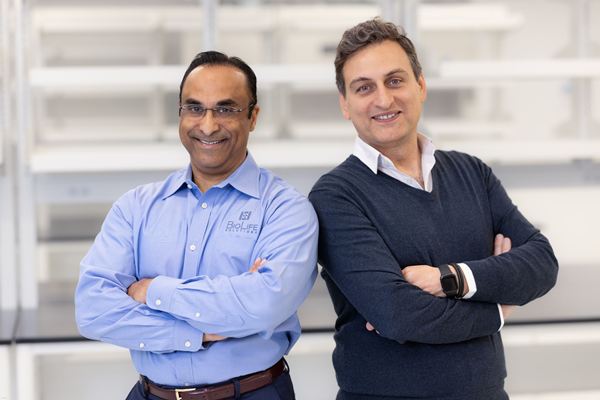
Aby J. Mathew, PhD & Alireza Abazari, PhD
PGCB Question: What problems in the field of biopreservation does the new center for excellence aim to address?
AJM Answer: For 25+ years, BioLife Solutions (and I) have been sharing educational information related to what I call “Biopreservation Best Practices”, and biopreservation/stability process optimization, etc. There is certainly more recognition now of the critical role that biopreservation plays in producing a successful clinical product. There is more awareness of the post-preservation problem of “Delayed Onset Cell Death”, and awareness that biopreservation issues can impact commercial success.
In the early days, our customers would usually conduct their own experiments to, hopefully, improve their biopreservation methods and process. We would often provide consulting assistance in partnership, but the customer would need to devote resources for this biopreservation optimization (people, time, etc.). These resources would be in addition to their primary focus areas on the development of their core product or therapy, their manufacturing, etc.
Many customers asked us if BioLife Solutions could do some of that biopreservation methods optimization for them, but we did not have the resource capabilities at that time. This meant that our customers would either have to continue with their internal resource investment, or they would contract a service provider, or perhaps they would not further optimize their biopreservation. Even for those customers who devoted internal resources or contracted a service provider, they might not be working with someone that had expertise in the field of biopreservation optimization.
Now, the Center for Biopreservation Excellence can assist clients who would like to offload resources investment to a partner with specific expertise in biopreservation and cell processing. We can also assist consulting services (CDMOs) who might find benefit in subcontracting the specialty of biopreservation optimization. Now we can directly address these areas where we have been a resource, and now we have a mechanism to offer additional hands-on support. The new Center is able to conduct cell-based testing, optimizing, validating, protocol development, and information transfer in support of the client’s GMP needs, provide follow-up support as needed, etc.
As much as the field of cell-based products and therapies has gained experience regarding biopreservation, there is still an ongoing need for focused education. The CGT field is developing more complex engineered cells, as well as 3-dimensional models such as organoids, that could benefit from ongoing research into Biopreservation Best Practices. BioLife Solutions and the Center for Biopreservation Excellence are available to assist with all of that.
PGCB Question: The Center for Biopreservation Excellence features 4,500 sq ft of state-of-the-art conference and laboratory space. Do you anticipate hosting any workshops or meetings in the field of biopreservation?
AJM Answer: Yes. Some of the planned goals would be for serving as a hub for training and collaboration with customers and industry partners, providing customized training programs, hosting customer workshops, and contributing to training the next generation of specialists. Our aspiration is to establish a knowledge base that will advance the science of biopreservation.
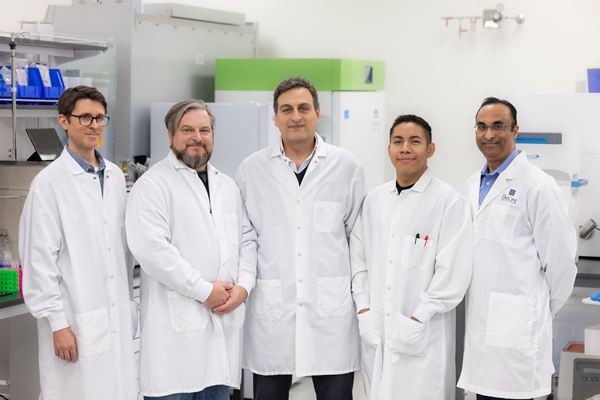
From left to right, Martin Campbell, MS, Sean Werner, PhD, Alireza Abazari, PhD, Jesus Moreno, MS, Aby J. Mathew, PhD.
PGCB Question: When your colleagues suggested naming the new center after you, what was your initial reaction?
AJM Answer: There were a variety of thoughts I had, when I was told about this. Those that know me these many years know that I am not one for having ‘the spotlight’, or attention, directed towards myself. I would like to think that it represents more so the Biopreservation Best Practices that I have advocated these many years, the high standards of excellence that I have tried to practice and lead by example; and also as representation of how much BioLife Solutions has accomplished within the cellular therapies field.
There are a lot of groups that have ‘Centers of Excellence’ these days. And often they are put out there by groups that do not necessarily have a history of demonstrating ‘Excellence’, and certainly not so much with a focus on biopreservation. So, I thought a bit about this journey of blessings, opportunity, serendipity, and life’s work, that has become BioLife Solutions, Inc.
Many of our colleagues in the field likely recall that it was not that long ago that everyone used home-brew cocktails to cryopreserve their cell products. And most did not pay much attention to the biopreservation steps in their process (or realize all the risks and issues they had built into their historical processes). In approximately 20 years or so, there has been a paradigm shift in the biopreservation of cell-based products and therapies.
Not only have the far majority of commercial novel cellular therapies incorporated our Biopreservation Best Practices and technologies; that also includes a number of our customers’ approved cell-based therapies, and a growing number of clinical center cellular therapies. Furthermore, BioLife Solutions (and I) facilitated this via education and consultative partnership with the cellular therapies field; which is very different from a traditional Sales & Marketing push like most others might have done (and most still do). We also stepped in, at times, when some generic solutions experienced market shortages, and BioLife Solutions was able to bring forth alternative options for our clinical partners. It is that history of excellence that this new Center for Biopreservation Excellence will be expected to live up to.