Sie sind hier

Changes to Childhood Vaccines in the US
Expectant parents often feel overwhelmed by the many decisions they need to make for their new baby. In January 2026, childhood vaccines became a new category of confusion. Robert F. Kennedy Jr. (RFKJr), the current head of the US Dept of Health and Human Services, commanded the Centers for Disease Control and Prevention (CDC) to announce a revised schedule of childhood vaccines. These revisions did not undergo any review by medical or scientific experts before they were announced.
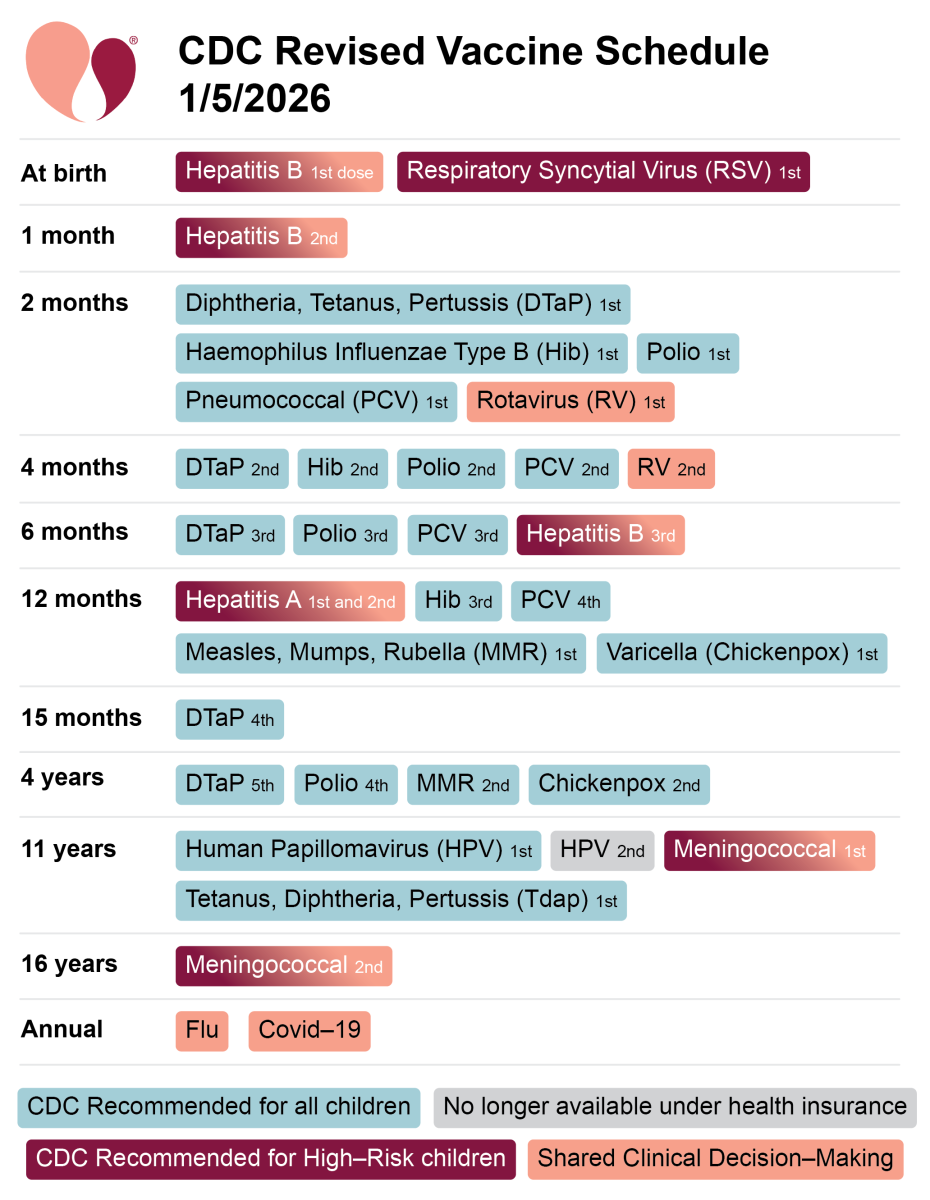
The number of diseases for which vaccines are recommended for all children have been reduced from 17 to 111,2. Vaccinations for the six remaining diseases will be available to children that are “high risk”, or they will be available after parents go through a process called Shared Clinical Decision-Making (SCDM). The six childhood diseases for which vaccines are no longer routinely recommended, listed by the age at which they would be given, are: Hepatitis-B, Respiratory Syncytial Virus (RSV), Rotavirus (RV), Hepatitis-A, Human Papillomavirus (HPV) 2nd shot, and Meningococcal vaccine. In addition, the CDC now considers annual vaccines for Flu and Covid-19 to be optional for children. We shall refer to the original vaccination schedule that was based on scientific evidence as the Standard Schedule and to RFKJr’s changes as the Revised Schedule.
Quick List of FAQ regarding childhood vaccines
- RULES: Are these changes mandatory? NO - you can ignore the revised schedule and still get all the childhood vaccines.
- PAYMENT: Will health insurance still pay for all the vaccines? YES – this is guaranteed through 2026.
- ACCESS: Will parents have to climb obstacles to get childhood vaccines? NOT REALLY – access to some vaccines will now require a conversation with a health care provider, but this can be accomplished simply by telling a pharmacist that you want the vaccine.
What do Medical Professionals Advise?
Public health experts and medical societies urge parents to continue to follow the standard vaccine schedule. Over 200 medical societies have stated their opposition to the revised vaccine schedule3. These include: the American Academy of Pediatrics (AAP), American Academy of Family Physicians (AAFP), the American Medical Association (AMA), the American College of Physicians, American College of Obstetricians and Gynecologists (ACOG), American Public Health Association, Infectious Diseases Society of America (IDSA), the Society for Maternal-Fetal Medicine, and many more.
The American Academy of Pediatrics (AAP) has taken the lead to maintain on-line resources for the standard vaccine schedule.
As of mid-January 2026, roughly half of US states have announced that they plan to ignore the revised schedule and follow vaccine guidance from the American Academy of Pediatrics4,5.
What are the Legal Mandates?
The CDC vaccine schedule does not carry a legal mandate. The CDC vaccine schedule has always been a list of recommendations from the federal government5. Traditionally, the CDC recommendations have been based on exhaustive review by a large panel of medical and scientific experts. In the past, medical societies have trusted this review panel and have adopted their expert recommendations. In 2026, because the revised schedule introduces drastic changes that are not based on evidence and study, experts are urging parents to ignore these revisions and follow the standard schedule.
Legally, only US states have the authority to mandate that a person get a vaccine, not the US federal government. This state power is based on a 1905 ruling from the US Supreme Court, after a fight over a state law that mandated the Smallpox vaccine6,7. Ironically, the WHO declared Smallpox eradicated in 1980, after a series of successful vaccination campaigns8. It is also legal for an employer to mandate a vaccine, but that is a topic about adults, not children7.
States enforce their childhood vaccine mandates primarily through their requirements to enroll in public schools. All 50 US states mandate some vaccines for children in public schools, but the list varies from state to state9. All 50 US states offer medical exemptions to the vaccine requirements, but the availability of non-medical exemptions for religious or personal reasons is variable9. In addition, many colleges and universities mandate the Meningococcal vaccine, which is given to older children10.
Some parents want their children to get all the vaccines, but they would like to space them out and give fewer shots simultaneously. Talk to your pediatrician about whether this is advisable and how to do it. When you submit the paperwork to start public school, the school simply wants to see that your child has received all of the vaccines on your state list, and they do not question the age or timing at which they were given.
What does Shared Clinical Decision-Making (SCDM) mean?
A literal translation for SCDM is “talk to your health care provider”. For the purposes of SCDM, health care providers include a wide range of medical professionals, from doctors to pharmacists. “In this context, CDC defines a health care provider as anyone who provides or administers vaccines: primary care physicians, specialists, physician assistants, nurse practitioners, registered nurses, and pharmacists”11.
The bottom line is that parents do not have to take extra time off from work just so that their child can get vaccinated. Very young children should routinely see their pediatrician anyway, and they will get their vaccines while they are there. But older children can get vaccines at the pharmacy department of your local grocery store. As a result, the procedure for getting vaccines does not have to be any different from before.
Shared Clinical Decision-Making has always taken place in settings where parents take their children for health care. Normally, medical doctors only use this phrase in situations “where the medical evidence does not give one clear recommendation”12. Hence, the use of this phrase in the CDC guidance is a subtle way of signaling that vaccines are no longer a standard of care. However, because the CDC guidance is not legally binding, health care providers are free to ignore that flag, and continue to follow the guidelines from the American Academy of Pediatrics. Due to the conflict between the advice of medical societies versus the CDC, conversations about vaccines will probably become more routine when parents seek health care for their children.
What type of public health policy is this?
The philosophy behind the revised vaccine schedule is to shift the US vaccine approach “away from population-level prevention and toward individualized risk assessment”1.
For example, RFKJr believes babies only need the Hepatitis-B (Hep-B) vaccine if their mother is infected with Hep-B. This type of risk-based vaccine policy can be successful in countries where there is very little risk of catching the disease, and where everyone has access to a universal health care safety net. One such country is Denmark, which relies on a risk-based approach to Hep-B vaccination.
However, the health care landscape in the US is very different from Denmark13. In the US, the risk-based approach to Hep-B was tried and failed decades ago. Thousands of children caught Hep-B each year, and 90% of them developed chronic infections which lead to liver failure, cancer, and early death1,14-17. In 1991, the CDC began recommending universal vaccination against Hep-B14-17. Since then, infections with Hep-B virus in children and teens have decreased 99%16. It is well known among public health experts that “to reduce infectious diseases, public health guidance has to be built for everyone”1.
Will health insurance providers continue to pay for all vaccines?
For the duration of 2026, the answer is YES. All of the major health insurance providers in the US have pledged that they will cover the cost of all the childhood vaccinations from the standard schedule during the year ahead2,18. This includes federal plans like Medicare, state plans like Medicaid, employer-sponsored health plans, and private insurance plans. The participation of Medicaid plans for low-income families is important, because nearly 4 in 10 children in the US are insured by Medicaid5.
Based on current regulations, most childhood vaccines will continue to be free after 2026. While the CDC schedule does not mandate what vaccines children must get, the CDC schedule does legally mandate what vaccines are covered by your health insurance plan. Several laws and regulations compel insurance plans to offer free coverage of the vaccines recommended by the CDC19. This guarantees that vaccines for the 11 diseases which are still covered by the revised CDC schedule will continue to be free19. Vaccines for the remaining six diseases which require Shared Clinical Decision-Making will also be free. Current CDC policy indicates that the insurance plan “coverage requirement includes shared clinical decision-making recommendations”11.
One exception where insurance coverage is going away is the vaccination for Human Papillomavirus (HPV), which has been reduced from two shots to one1. Since the HPV vaccine was introduced in 2006, it has proven 97% effective in preventing cervical cancer and nearly 100% effective in preventing genital warts20. The HPV vaccine is so effective that some public health experts have argued that one shot is sufficient, and the second shot is not necessary21. The first HPV shot is still covered under the CDC’s revised vaccine schedule. The second HPV shot is not included under the revised vaccine schedule, not even after Shared Clinical Decision-Making, so this shot will no longer be covered by health insurance plans1.
To summarize
In the immediate future, most parents will not see significant changes to childhood vaccination procedures. Some parents may question why there is so much fuss about the CDC’s revised schedule for childhood vaccines. A comprehensive survey of vaccine views among US parents of young children, conducted during the summer of 2025, found that despite some of their opinions splitting along political lines, nonetheless 90% of parents have positive views of the well-established childhood vaccines, and parents continue to rate their pediatrician as their most trusted source of information22.
However, in the long term there may be noticeable consequences from the CDC changes. If some US states follow the lead of the CDC and remove certain vaccines from their requirements for public school, this can lead to lower levels of community immunization. For example, Governor Ron DeSantis of Florida has proposed eliminating their vaccine mandates for public school, and currently their legislature is debating several bills that would modify procedures for giving childhood vaccines23. Lower levels of vaccine adoption will lead to outbreaks of preventable diseases such as Measles, Whooping Cough, and Hepatits-B. And after Covid-19, we all know that disease outbreaks which begin in one place can easily cross borders.
“Unfortunately, it’s becoming increasingly clear that we can no longer trust the leadership of our federal government for credible information about vaccines, and that’s a tragedy that will cause needless suffering,” said Dr. Sean O’Leary, chair of the infectious disease committee at the American Academy of Pediatrics2.
References
- Jetelina K. A unilateral change to childhood vaccines: What it means for you. Your Local Epidemiologist. Published 2026-01-06
- Mandavilli A. Kennedy Scales Back the Number of Vaccines Recommended for Children. New York Times. Published 2026-01-05
- Infectious Diseases Society of America. IDSA and over 200 health organizations urge Congress to conduct oversight of changes to vaccine schedule. Petition. Last Updated 2026-01-09
- Szabo L. States, health organizations reject new CDC vaccine guidance. University of Minnesota Center for Infectious Disease Research and Policy (CIDRAP). Published 2026-01-12
- Kates J, Michaud J. The New Federal Vaccine Schedule for Children: What Changed and What Are the Implications? Kaiser Family Foundation Policy Brief. Published 2026-01-09
- MacArthur S. Can Vaccines Be Mandated by Law? MPHonline. Accessed 2026-01-23
- Fraser EM, Neuss MJ. Who Calls the Shots? A Legal and Historical Perspective on Vaccine Mandates. Chest. 2022; 162(3):659–663.
- National Foundation for Infectious Diseases. The Triumph of Science: The Incredible Story of Smallpox Eradication. News and Updates. Published 2023-05-08
- National Council of State Legislatures. State Non-Medical Exemptions From School Immunization Requirements. Brief. Published 2025-07-24
- National Council of State Legislatures. State Vaccine Requirements for College Entry. Summary. Published 2025-02-03
- CDC Advisory Committee on Immunization Practices (ACIP). ACIP Shared Clinical Decision-Making Recommendations. For Everyone. Published 2026-01-07
- Panthagani K. Shared decision-making, informed consent, and the rhetoric of false empowerment. Your Local Epidemiologist. Published 2026-01-28
- Godoy M. Should the U.S. model its vaccine policy on Denmark's? Experts say we're nothing alike. National Public Radio. Published 2025-12-26
- Immunize.org. Vaccine History Timeline. Last updated 2025-09-02
- Hepatitis B Foundation. Hepatitis B Facts and Figures. Accessed 2026-01-23 MEDIA KIT: https://www.hepb.org/resources-and-support/hep-b-birth-dose-media-toolkit/
- Rosen A. Hepatitis B Vaccination is an Essential Safety Net for Newborns. Office of External Affairs at the Johns Hopkins Bloomberg School of Public Health. Published 2025-09-24
- George Washington University Milken Institute of Public Health. Dozens of Public Health and Policy Experts, Along with the American Public Health Association, Urge the CDC to Maintain Universal Newborn Hepatitis B Vaccination. Published 2025-12-02
- America's Health Insurance Plans. AHIP Statement on Vaccine Coverage. Press Release. Published 2025-09-16
- Kates J. ACIP, CDC, and Insurance Coverage of Vaccines in the United States. Kaiser Family Foundation Policy Brief. Published 2025-06-13
- Deak P. What I Tell Every Patient About the HPV Vaccine. American College of Obstetricians & Gynecologists (ACOG) Expert View. Last updated 2024-11
- Johns Hopkins Bloomberg School of Public Health. The Power of a Single Dose: Evidence for a Single-Dose HPV Vaccine Schedule. Evidence Brief. Accessed 2026-01-23
- Kearney A, Montero A, Valdes I, Hamel L, Kirzinger A. KFF/The Washington Post Survey of Parents. Kaiser Family Foundation Poll Finding. Published 2025-10-10
- Sexton C. Vax still required for school children; opt outs expanded under Senate bill. Florida Phoenix. Published 2026-01-26